
History
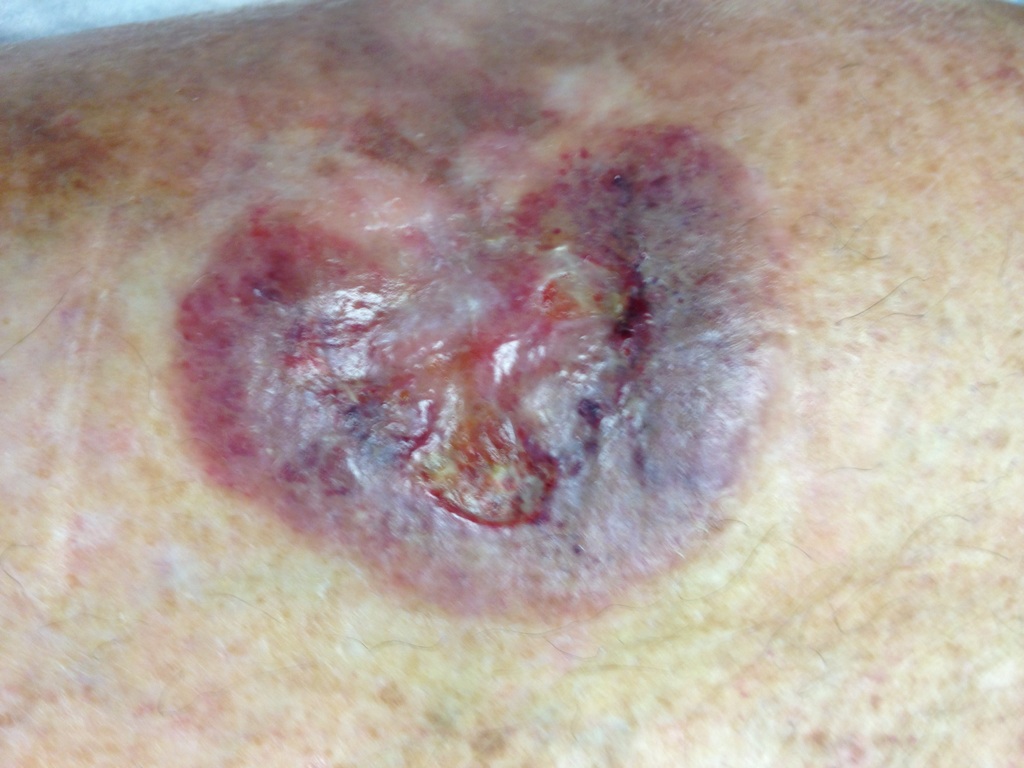
Patient is a 75 year old diabetic male with a history of an ulcer of the left anterior pre-tibial region, which has been opening and closing for the past 2 years. He has never sought medical care for this area in the past. He does report repeated but minimal trauma to the area, mostly small bumps and scratches. It is complicated by 2-3+ edema in the lower leg secondary to venous disease. The area is not painful although at initial presentation it was clinically infected. 3 biopsies were performed at the onset all of which were negative for malignancy and showed histology consistent with a chronic ulcer. It was healing with compression and topical collagen but the area was becoming more discolored (see picture) and the edges were raised and atypical appearing. Repeat biopsy was performed.
Biopsy report
Palisading granulomas with multinuclear/giant cells present consistent with necrobiosis lipoidica diabeticorum
Diagnosis: Necrobiosis lipoidica diabeticorum
Necrobiosis lipoidica is a disorder of collagen degeneration with a granulomatous response, thickening of blood vessel walls, and fat deposition. The main complication of the disease is ulceration, usually occurring after trauma. Infections can occur but are uncommon.
Treatment
Treatment is based on theory as the true pathology is not completely understood. Below are some common treatments employed.
- Pentoxyphylline: Medications such as trental are indicated as it is theorized they improve blood flow and inhibit platelet aggregation.
- Aspirin: Inhibits platelet aggregation in improves platelet survival time
- Dipyrimidole: Inhibits platelet aggregation in improves platelet survival time
- Clofazimine (Lamprene): Known to have anti-inflammatory properties, but its mechanism of action is unknown
- Heparin (intralesional): Inhibits thrombogeneisis
- Retanoids: regulate cell growth and differentiation
- Topical and intralesional corticosteroids: Can lessen the inflammation of early active lesions and the active borders of enlarging lesions
- Tacrolimus/Cyclosporine: Can lessen the inflammation
- PUVA light therapy
- Surgical excision and grafting
Leave a Reply