
Ankle Brachial Index (ABI)
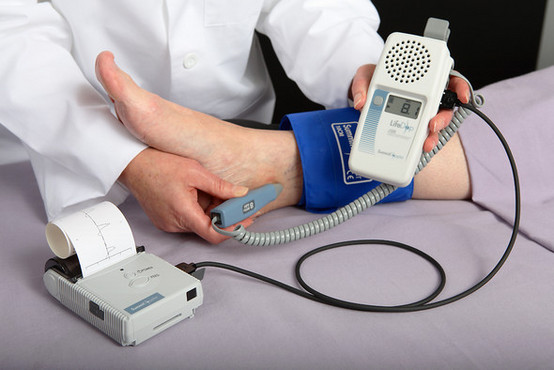
The ankle brachial index study is a simple yet effective tool, which can be used in a wound care center or private practice office, for the diagnosis of peripheral arterial disease. The ABI study is easy to perform and non-invasive. I happen to use a small hand-held unit manufactured by Summit Doppler. A comprehensive video on performing, documenting and interpreting the study is available by clicking here.
Compares perfusion pressure in the upper arm and the lower leg
- Commonly performed to:
- Assess presence of arterial disease
- Assess patient safety for compression therapy
- ABI >1.3 to 0.8- safe to have full compression therapy (30-40 mmHg at the ankle)
- ABI 0.8 to 0.5- reduced compression therapy is recommended (<30 mmHg at the ankle)
- ABI <0.5 – compression therapy is contraindicated
False negative tests or elevated ABI measurements can occur in non-compressible arterial disease
- Non-compressible disease can occur in diabetes and calcified vessels
- If there is clinical evidence of ischemia but normal or elevated ABI measurements refer for definitive testing.
ABI >/= 1 to 1.3 Normal
ABI < 0.5 Severe ischemia
ABI >1.3 Non-compressible disease
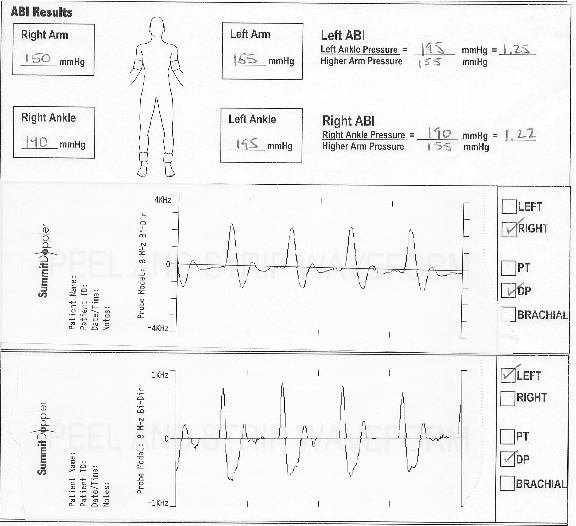
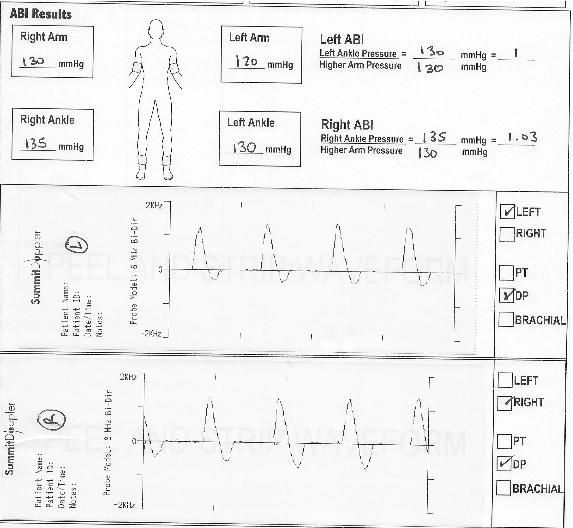
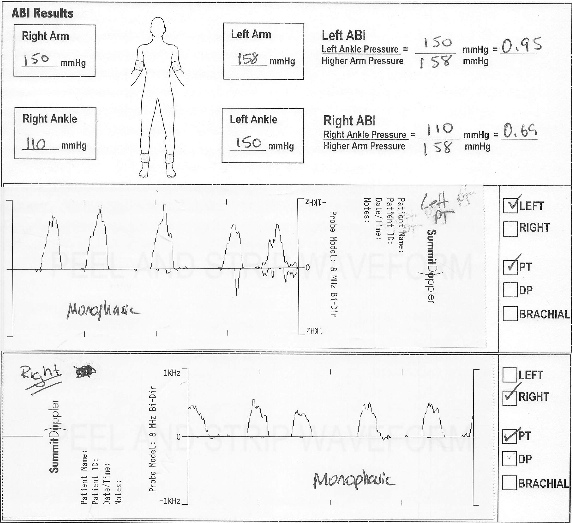
In addition to calculating an ABI, a hand-held doppler with a printer will also allow you to print waveforms to assess. The waveform helps you assess the “health” of the vessel you’re interrogating. Three possible waveforms may be encountered
- Triphasic: Normal “healthy” blood vessels have a triphasic waveform, with a sharp upstroke and the downstroke and then returns to above the baseline. Healthy vessels have more elasticity which creates the triphasic waveform as a response to the pulsation of the blood through the vessel.

Triphasic waveform with normal ABI - Biphasic: This waveform is considered healthy but mildly abnormal.

Biphasic waveforms with normal ABI - Monophasic: A flat waveform consistent with more progressive disease.

Monophasic waveform with abnormal ABI
Toe Brachial Index (TBI)
Compares perfusion pressure in the upper arm and the toes
- Performed for screening for arterial disease
Toe pressures are more accurate than ABI studies when vessels are calcified and non-compressible
TBI >0.6 is normal
Leave a Reply